A Well Paddled book
Find your size on the makers' own charts
Anyone can open a maker's size chart. The hard part is reading it: makers measure in different ways, and two charts can give two answers for the same body. Kayak Sizing and Fit shows you what to measure, sets the makers' charts side by side, and tells you how to check the fit.

See the Kindle ebook on Amazon (paid link)
Amazon shows the current price.
As an Amazon Associate, Well Paddled earns from qualifying purchases.
For you if you are choosing a kayak, a paddle or a life jacket, and most of all if you are choosing more than one of them. Two chapters are for paddling with a child. The book covers size and fit only and does not teach paddling safety.
Go to: A first kayak Paddling with a child A paddle A life jacket
What a size chart does not tell you
Three examples from the book.
A paddle. A paddler 5 feet 8 inches tall in a kayak 25.5 inches wide gets 220 centimeters from Aqua Bound's chart. NRS's chart for a low-angle stroke, where you hold the paddle fairly level, gives 230 centimeters.
A child's life jacket. Two jackets have "Child" in their name. Stohlquist's is for a child of 30 to 50 pounds, the NRS Crew Child for 33 to 55 pounds.
A kayak. Old Town states a capacity of 500 pounds for its Sportsman 120. It counts 415 of them as usable: the weight left for people, gear and pets after the weight of the boat itself.
The book's rule: "use the chart for the exact model you are considering, and follow that maker's way of measuring. Do not average two charts or carry one maker's adjustment into another maker's chart."
That rule sends you to one maker's chart. The book is for the work around the chart, and it says to read it "before you buy or before you try anything on". Most chapters go in three steps:
- Measure. What the chart asks for, and how that maker wants it measured.
- Read the chart. The makers' rows side by side, each with its source. The book says where a chart has a gap, where two sizes fit, and where a maker's page gives no figure.
- Check the fit. What to look for when you sit in the boat, put the jacket on or try the paddle.
Go to what you are choosing
The book has an introduction and 12 chapters. Here is what it gives you for each choice.
A first kayak
Chapters 2 to 5. For when you do not own a kayak yet: what to measure before you shop, what a capacity figure means, and what to check in the seat.
The book shows what the makers publish for a kayak, and what to check on every kayak you look at. It does not pick a kayak for you, and no table in it turns your height into one kayak length.
Measure. Write down your height and your weight, and add the gear and water you will carry. Measure the place where the kayak will be stored, the way it must pass to get there, and the space on your vehicle or rack.
Read what the maker publishes. A capacity figure is a load limit for you, your gear and water. It is not a size for your body. Chapter 2 lists the stated capacity and size of twelve kayaks. Two of them:
Old Town Sportsman 120
Maximum capacity: 500 lb (415 lb usable), Length and width: 12 ft by 33.5 in1
Intex Challenger K1
Maximum capacity: 220 lb, Length and width: 9 ft by 2 ft 6 in inflated11
Two rows of the first table in chapter 2, as the ebook prints them. "Usable" is the weight left for people, gear and pets after the weight of the boat. The small numbers lead to the notes that name each source.
Some makers also say whom a kayak fits: a paddler weight range for each size of a whitewater kayak (a kayak for moving river water), a paddler size or a maximum paddler weight for a sea kayak. Chapter 3 says what length and width suggest about handling. Longer kayaks tend to be faster and to hold a straight course. Shorter kayaks tend to be easier to turn. A wider kayak may feel steadier, while a narrower one needs less effort to reach the same speed.
Check the fit in the seat. No chart does this for you. From chapter 2: "Sit in the seat and check your contact with the footpegs and cockpit sides. The balls of your feet should rest on the footpegs with a slight bend in your knees. Your bent knees should make firm contact with each side of the cockpit." Footpegs are the supports for your feet. The cockpit is the opening where you sit.
So before you sit in any kayak, you can rule out the ones that cannot carry your load or do not fit your storage space. The seat check is for the ones that are left.
- 2. Kayak size by height and weight and 3. Kayak length and width hold the steps above.
- 4. Cockpit size and fit. How to measure for a spray skirt, which fits over the rim of the cockpit to cover it, or for a cockpit cover. How to check your fit in the seat. If you already own a kayak, start here.
- 5. Whitewater kayak sizing. Weight ranges for each size of three boats from Jackson Kayak and Pyranha. One weight can fit two sizes: at 165 pounds, Pyranha's chart for the Ripper 2 puts you at the top end of Small and inside Medium. The chapter says how the two sizes differ in handling and tells you to check the fit in the boat.
Paddling with a child
Chapters 6 and 8. Where a child sits at what age, two kayaks made for children, life jackets by the child's weight, and four steps to check the fit.
The boat. Chapter 6 starts with one decision: whether your child will paddle or ride as a passenger. It gives REI's approximate ages for each place in a boat. Two of them: a paddler in the front seat of a kayak for two, 8 and older; a skilled paddler in a small kayak of their own, 10 and older. REI's ages are approximate. They take account of things such as swimming ability, experience and strength.
The makers of two kayaks for children state their own ages. Lifetime recommends its Wave 60 Youth Kayak from age 5 with adult supervision. Perception's figures are in this row:
Perception Hi Five 6.5, a solo child boat
Seats: One child in an elevated molded seat; Perception says it typically covers ages 5–14, depending on the paddler’s size and skill, Storage and carrying: 72 inches (6 feet, 1.83 meters) long; 26.5 pounds (12.02 kilograms), Maximum load: Maximum weight capacity: 120 pounds (54.43 kilograms).5
One row of the table in chapter 6, as the ebook prints it.
The table's other two boats are kayaks for up to two paddlers plus a "small child": the Ocean Kayak Malibu Two and Malibu Two XL.
The life jacket. Chapter 8 starts with your child's weight. For some jackets you need the chest measurement too. Two rows of its table:
NRS Crew Child
Child’s weight: 33–55 pounds (15–25 kilograms), Approval type and other size notes: Newer USCG/Transport Canada Level 70 approval; chest 22–25 inches (56–64 centimeters).2
NRS Crew Youth
Child’s weight: 55–88 pounds (25–40 kilograms), Approval type and other size notes: Newer USCG/Transport Canada Level 70 approval; chest 24–29 inches (61–74 centimeters), including apparel layers.3
Two rows of the table in chapter 8, as the ebook prints them. USCG is the United States Coast Guard; Level 70 is a kind of approval.
NRS's general fitting guide draws the line at another weight: child 30 to 50 pounds, youth 50 to 90 pounds. The book prints it in the same table and says which to follow: "Each maker's bands, and each model's, are its own, so follow the label and size chart of the jacket you are buying."
Then come four steps to adjust the jacket and check that it stays in place:
- Release the strap tension before putting the jacket on. Close the entry zipper or buckles, beginning with the bottom buckle where fitted, and fasten all straps and ties.
- Take up slack evenly from the bottom upward, adjusting the shoulders last. Keep the jacket centered, snug and comfortable, then tuck away loose strap ends.
- Lift the jacket at the shoulders and watch for upward movement. It should stay below your child's chin and ears. If it rises too far, readjust it; if it still slips over them, try another size.
- Fasten any supplied leg straps, which pass between the legs to help limit ride-up. They cannot make up for poor fit: the jacket should already fit snugly without them.
The four steps as chapter 8 prints them, without their note numbers. The notes credit NRS and the U.S. Coast Guard.
After the steps the chapter describes a supervised test in shallow water, and it gives the US federal rule on children wearing life jackets.
The paddle. The book has no paddle chart made for children. Its charts for kayak paddles go by the paddler's height, and Aqua Bound's chart has rows for paddlers under 5 feet tall.
A paddle
Chapters 9 to 12. Your height, the width of your kayak, and what to do when two charts or two rows give two lengths.
Measure. A paddle length chart asks for your height and for the width of your kayak at its widest point. Chapter 9 adds two things that can change the answer: how high your seat is, and whether you hold the paddle fairly level (a low-angle stroke) or more upright (a high-angle stroke).
Read the chart. Take a paddler 5 feet 8 inches tall in a kayak 25.5 inches wide. Three rows of the chapter's table:
Aqua Bound
Your height: 5 feet 7 inches to 6 feet, Boat width: 23 to 27.75 inches, Paddle length: 220 cm1
NRS low-angle
Your height: 5 feet 6 inches to 6 feet 2 inches, Boat width: 23 to 26 inches, Paddle length: 230 cm3
NRS high-angle
Your height: 5 feet 6 inches to 6 feet 2 inches, Boat width: 23 to 26 inches, Paddle length: 215 cm3
Three rows of the paddle length table in chapter 9, as the ebook prints them.
This paddler's height and boat width are inside all three rows. The book says what each chart is for. Aqua Bound's is one general chart for recreational, touring and performance kayaks; Bending Branches uses the same height and width groups and also gives 220 centimeters. NRS has one chart for each stroke, and of those two the book says: "Here the stroke input changes, so these are recommendations for different uses."
Charts also have gaps and overlaps. This is the chapter's section on them:
Aqua Bound’s chart leaves intervals between its printed categories: kayak widths between 27.75 and 28 inches, and heights between 5 feet 6 inches and 5 feet 7 inches. Its grid does not assign every measurement within those intervals a length. For a paddler 5 feet 8 inches tall, its chart result changes from 220 centimeters at a kayak width of 27.5 inches to 230 centimeters at 28.5 inches. Do not silently extend a category to cover your measurement.
NRS's low-angle rows overlap at a kayak width of 23 inches for a paddler 5 feet 8 inches tall, giving both 220 centimeters and 230 centimeters.
If your measurements match overlapping rows or fall outside every row, we suggest taking your exact measurements and paddle type to a paddle shop for help choosing a length.
The section "Recognize gaps and overlaps" in chapter 9, whole, without its note numbers.
For a paddler between two sizes, the chapter passes on REI's general advice: take the shorter one, unless your torso is short for your height. It also lists the conditions under which Bending Branches and Aqua Bound advise at least 5 centimeters more or less.
Check the fit. A chart gives you a length to start with. Then, in the book's words: "Try the candidate length with your boat and the seat position recorded earlier." Knuckles hitting the boat, or having to lean into your strokes, can mean the paddle is too short (Bending Branches). Too long: the paddle can strain your shoulders and make the kayak zigzag (Aqua Bound).
The chart and the check both need a kayak. The paddle charts ask for your kayak's width, so if you are buying both, settle the kayak first.
- 9. Kayak paddle length and blade. The steps above, then the shaft, the joint and the blade.
- 10. Paddle length for wide boats and elevated seats. The fishing-paddle charts of Bending Branches and Werner, for wide kayaks and raised seats.
- 11. Greenland paddle sizing. For paddles with long, thin blades: how CJW, Tuktu, Valkyrie Craft and Beale each measure for one.
- 12. Canoe and paddle board paddle sizing. Canoe paddle length from a seated measurement, paddle board paddle length from your height.
A life jacket for yourself
Chapter 7. Your chest, the maker's chart, and what to do when two sizes fit.
Measure. Your chest, in the way the jacket's maker asks for it. The chapter's warning: "Your familiar size name does not transfer between makers."
Read the chart. Chapter 7 has the size rows of four jackets from NRS, Astral and Stohlquist. Two rows for one of them:
NRS Ninja PFD, graded XS/M
Chest measurement: 30–38 inches (76–97 centimeters), Your weight: 88–154 pounds (40–70 kilograms).5
NRS Ninja PFD, graded M/L
Chest measurement: 36–46 inches (91–117 centimeters), Your weight: 88 pounds and above (40 kilograms and above).5
Two rows of a table in chapter 7, as the ebook prints them. PFD means personal flotation device, the term for a life jacket.
A chest of 37 inches is inside both sizes. The book says what to do: "Where chest ranges overlap, we recommend trying the eligible sizes using the fitting checks below."
Check the fit. The checks are credited to NRS: "You should be able to put the jacket on and fasten it comfortably. If you cannot, it is too small. If adjustment cannot make it snug, it is too big." Then someone pulls up on the shoulder straps. If the jacket moves over your ears, it is too loose or too large, or its design may not suit your body. The chapter ends with a test in the water.
For every reader
- Introduction. How to read one table row.
- 1. How to measure yourself and your boat. The measuring for all the other chapters. Makers do not all measure in the same way: for a canoe paddle, Bending Branches measures from the seat to your nose, Grey Owl Paddles from the seat to your chin, and REI Co-op from the floor to your nose while you kneel.
The book covers the makers and models it names, not every model on the market. If yours is not in it, the book's rule still applies: use that maker's own chart and its way of measuring.
Where the figures come from
The book does not ask you to take its author's word. It works with published figures. Each one is credited to whoever publishes it: a maker such as NRS or Aqua Bound, a shop such as REI Co-op, or an agency such as the U.S. Coast Guard. The note behind a figure gives the source, when it was read and its web address. This is the note behind Aqua Bound's 220 centimeters:
- Aqua Bound, Kayak Paddle Sizing Guide (retrieved October 16, 2026). https://www.aquabound.com/pages/kayak-paddle-sizing-guide
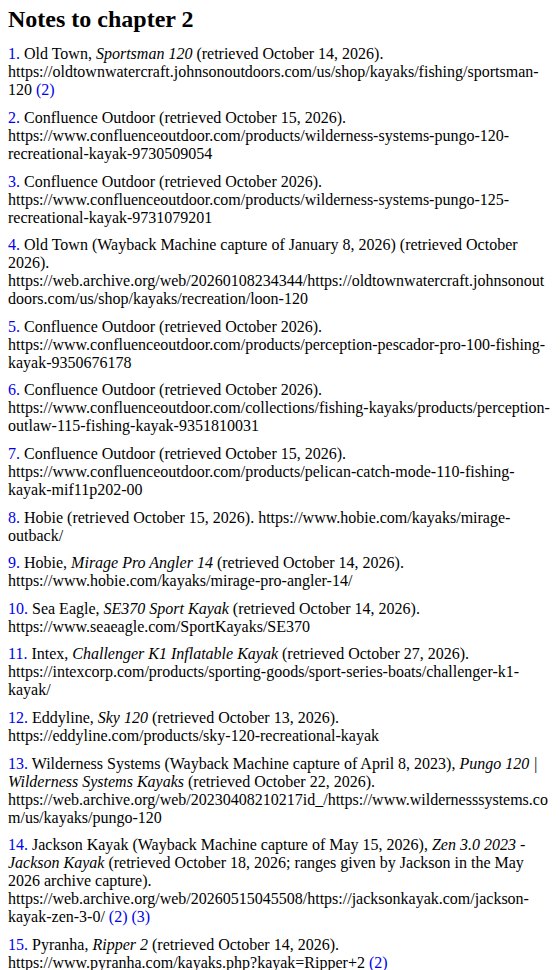
So you can open the maker's page and check a figure yourself. The book gives its figures as of October 2026. Before you buy, look at the maker's page to see that nothing has changed.
Where a maker's page gives no figure, the book says so. Chapter 6 lists a kayak with seats for one or two paddlers plus a "small child". In the same row the book adds: "Old Town's page gives no age or weight range for this term."
Where the figures on a maker's page do not agree, the book says that too. From chapter 4:
"Eddyline’s page lists the Sandpiper 120 cockpit size on one line as 48 x 22" / 122 x 45 cm. The inch width and the metric width do not agree with each other, so ask Eddyline which is right before you rely on the width."
All 132 sources stand once more in one list at the end of the book, each with the chapters that cite it.
Good to know before you buy
- Size and fit only. In the book's own words: "This book covers size and fit only, as of October 2026. It does not teach paddling safety, rescue or cold-water skills; learn those from a qualified instructor before you paddle."
- A chart gives you sizes to try, not a promise. For life jackets the book puts it this way: "A life jacket's size chart gives you candidates to try; the fitting checks show whether a candidate suits your body."
- It does not pick a model for you. The book does not rank brands or name a model to buy. It gives you what to check on each model you look at: what the maker's chart asks for, what it gives, and how to check the fit.
- Drawn from the guides on this site. The book's text is drawn from the size and fit guides on this site, and from the maker and agency pages those guides cite. In the book it stands in one place and in one order, with one contents page and one list of sources.
- Inches and pounds first. Most sizes are in inches, feet and pounds. Many, but not all, also have centimeters and kilograms. The life jacket chapters use U.S. Coast Guard approvals and the US federal rule on children wearing life jackets.
- A short reference book. It has 12 chapters and 23 tables, with about 12,000 words of chapter text. It is made for looking one thing up at a time.
How you read it
The book is a Kindle ebook. You do not need a Kindle device: Amazon's free Kindle app lets you read Kindle books on a phone, a tablet or a computer.
The text wraps to fit your screen. No table is wider than the screen. Every table row is a short block like the ones above, with the name in bold and a label before each figure. Each small number is a link to its note, and the note links back.
To find your place, the contents page links to every chapter, and the Introduction has a list called "Where to look" with one line for each chapter. Where one chapter points to another, as in "(see chapter 4)", that is a link too.
Inside, the book has no photos and no drawings. The checks are described in words, like the four steps for a child's life jacket above.
See the Kindle ebook on Amazon (paid link)
Amazon shows the current price.
As an Amazon Associate, Well Paddled earns from qualifying purchases.
Kayak Sizing and Fit: Makers’ Own Charts for Kayaks, Paddles and Life Jackets, Side by Side. By Jamie Strand. First published in 2026 by Akayak.
Not ready for a book? Start with the size guides on this site: kayak size for your height and weight, life jacket sizing and fit, kids' life jackets, kayaking with kids, paddle length charts.